To see accurate pricing, please choose your delivery country.
 
 
United States
£ GBP
All Shops
Important Notice for US Customers

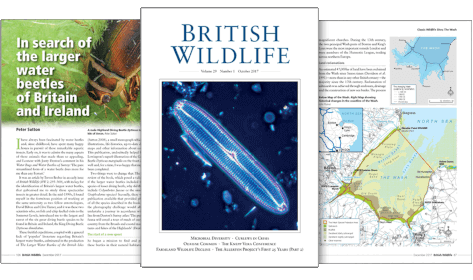
British Wildlife

8 issues per year 84 pages per issue Subscription only

British Wildlife is the leading natural history magazine in the UK, providing essential reading for both enthusiast and professional naturalists and wildlife conservationists. Published eight times a year, British Wildlife bridges the gap between popular writing and scientific literature through a combination of long-form articles, regular columns and reports, book reviews and letters.

Subscriptions from £33 per year

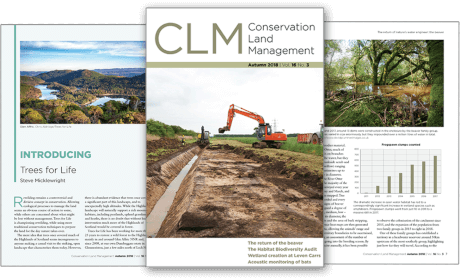
Conservation Land Management

4 issues per year 44 pages per issue Subscription only

Conservation Land Management (CLM) is a quarterly magazine that is widely regarded as essential reading for all who are involved in land management for nature conservation, across the British Isles. CLM includes long-form articles, events listings, publication reviews, new product information and updates, reports of conferences and letters.

Subscriptions from £26 per year
Academic & Professional Books  Environmental & Social Studies  Economics, Politics & Policy  Politics, Policy & Planning  Politics, Policy & Planning: General

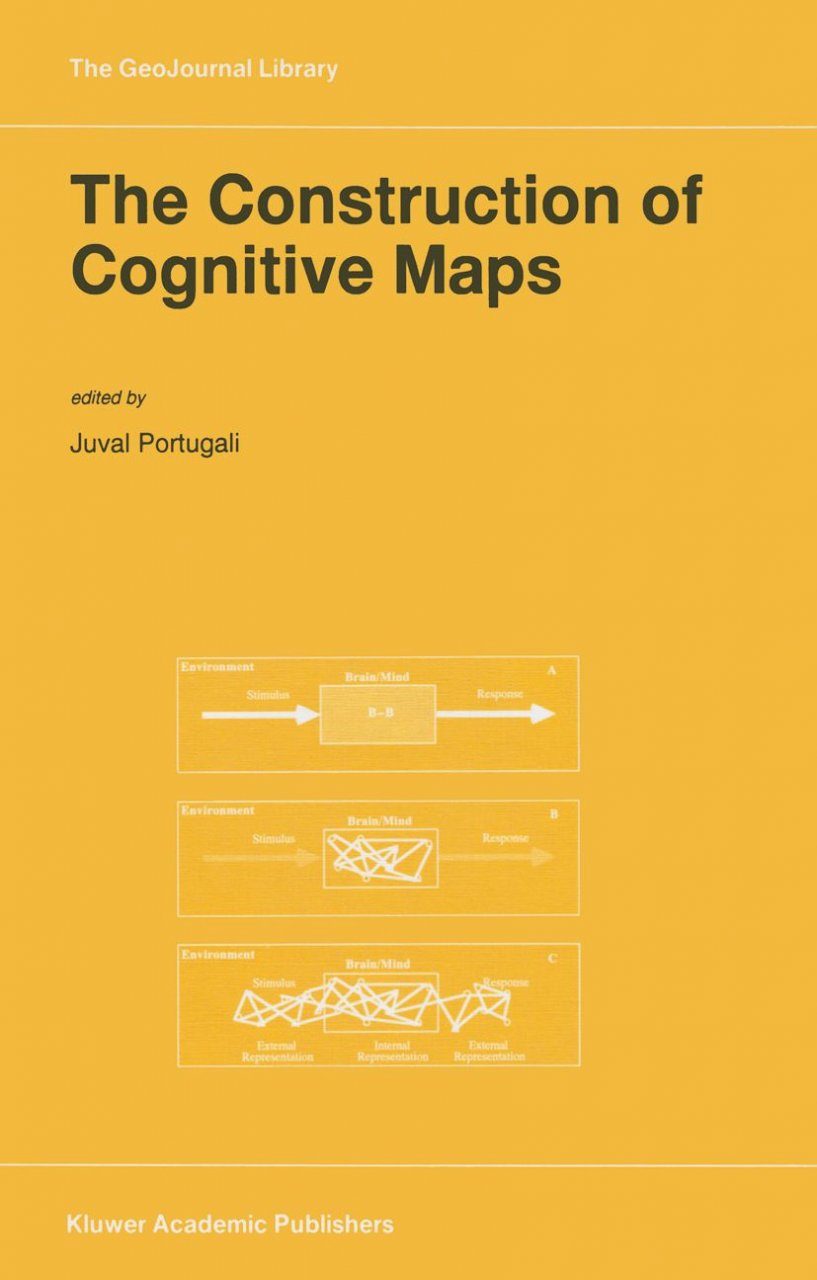
The Construction of Cognitive Maps

Series: Geojournal Library Volume: 32
Edited By: J Portugali
384 pages
Publisher: Springer Nature
The Construction of Cognitive Maps
Click to have a closer look
  • The Construction of Cognitive Maps ISBN: 9780792339496 Hardback Mar 1996 Not in stock: Usually dispatched within 1-2 weeks
    £129.99
    #156301
Price: £129.99
About this book Contents Customer reviews Related titles

About this book

This book sheds light on processes associated with the construction of cognitive maps, that is to say, with the construction of internal representations of very large spatial entities such as towns, cities, neighborhoods, landscapes, metropolitan areas, environments and the like. Because of their size, such entities can never be seen in their entirety, and consequently one constructs their internal representation by means of visual, as well as non-visual, modes of sensation and information - text, auditory, haptic and olfactory means for example - or by inference. Intersensory coordination and information transfer thus play a crucial role in the construction of cognitive maps. Because it involves a multiplicity of sensational and informational modes, the issue of cognitive maps does not fall into any single traditional cognitive field, but rather into, and often in between, several of them. Thus, although one is dealing here with processes associated with almost every aspect of our daily life, the subject has received relatively marginal scientific attention.
The book is directed to researchers and students of cognitive mapping and environmental cognition. In particular it focuses on the cognitive processes by which one form of information, say haptic, is being transformed into another, say a visual image, and by which multiple forms of information participate in constructing cognitive maps.

Contents

The Construction of Cognitive Maps: An Introduction; J. Portugali. Part One: Theoretical Frameworks. Inter-representation Networks and Cognitive Mappings; J. Portugali. Synergetics, Inter-representation Networks and Cognitive Maps; H. Haken, J. Portugali. Connectionism and Neural Networks. Neural Network Models of Cognitive Maps; S. Gopal. Connectionist Models in Spatial Cognition; T. Ghiselli-Crippa, et al. The Ecological Approach. The Ecological Approach to Navigation: A Gibsonian Perspective; H. Heft. Experiential Realism. Verbal Directions for Way-Finding: Space, Cognition and Language; H. Couclelis. Part Two: Transformations. From Visual Information to Cognitive Maps. Vision: From Visual Information to Cognitive Maps; J. Sholl. Constructing Cognitive Maps with Orientation Biases; R. Lloyd, R. Cammack. Cognitive Maps by Visually Impaired People. Cognitive Mapping and Wayfinding by Adults Without Vision; R.G. Golledge, et al. The Construction of Cognitive Maps by Children with Visual Impairments; S. Ungar, et al. From Language to Cognitive Maps. Language as a Means of Constructing and Conveying Cognitive Maps; N. Franklin. Modes of Linearization in the description of Spatial Configurations; M.-P. Daniel, et al. Part Three: Specific Themes. Spatial Reasoning. Modeling Directional Knowledge and Reasoning in Environmental Space: Testing Qualitative Metrics; D.R. Montello, A.U. Frank. Cognitive Mapping and Culture. Mapping as a Cultural Universal; D. Stea, et al.

Customer Reviews

Series: Geojournal Library Volume: 32
Edited By: J Portugali
384 pages
Publisher: Springer Nature
Current promotions
Great GiftsNew and Forthcoming BooksBritish Wildlife Magazine SubscriptionField Guide Sale 2025